Constraint-Native AI. Inverting The Pyramid.
AI this. AI That. Africa will win. Africa will be left out. Decided to use my actual CPU and think through Africa's AI opportunity, where it could shine, and what might be a surprise.


The last few weeks have moved very fast at AfricAI Group. In parallel to building our thesis, tech, and working with clients, we have started spending more time on what the AI opportunity in Africa can look like. While business-wise we are all about AI solutions for the corporate environment in Africa, through the Africa x AI community (a WhatsApp group, ping me if you'd like to join) and various recent and upcoming engagements, I found myself taking a step back and looking at a wider picture. Trying to make sense of the obvious and less obvious AI opportunities, challenges and risks that are more specific to the continent.
I have no intent of trying to solve or opine on all at once, and as the pace of change is unbelievable, I have deep and grounded views this week which may turn different the next one. So no commitment to hold these forever, but trying to make initial sense of what I am seeing, hearing and learning, given the many engagements on this topic with a sharp crowd from several avenues of Africa and AI.
In a sentence, I think AI in Africa might end up innovative in ways that travel, because of the many constraints it has to build within. Either way, the playbook will be different, the opportunities more refined, and there's a chance this has wider relevance globally with time. Hard to predict. I'll come back to it.
My focus these days is AI deployed in Africa, less so AI built in Africa for the developed world. There is a lot to say about the latter, including the implications on non-AI-centric businesses from the continent going elsewhere, but that’s not what this piece is about. All thoughts are my own, as always. Would love a heated discussion and some pushing back. Time to connect the software to the hardware.
AI is everything nowadays, and as such it is also nothing. Too many things to think through at once. So as a framework, here is how I think of it as a stack, how value is and can be captured, and how that helps me distinguish what any of this actually means for us.
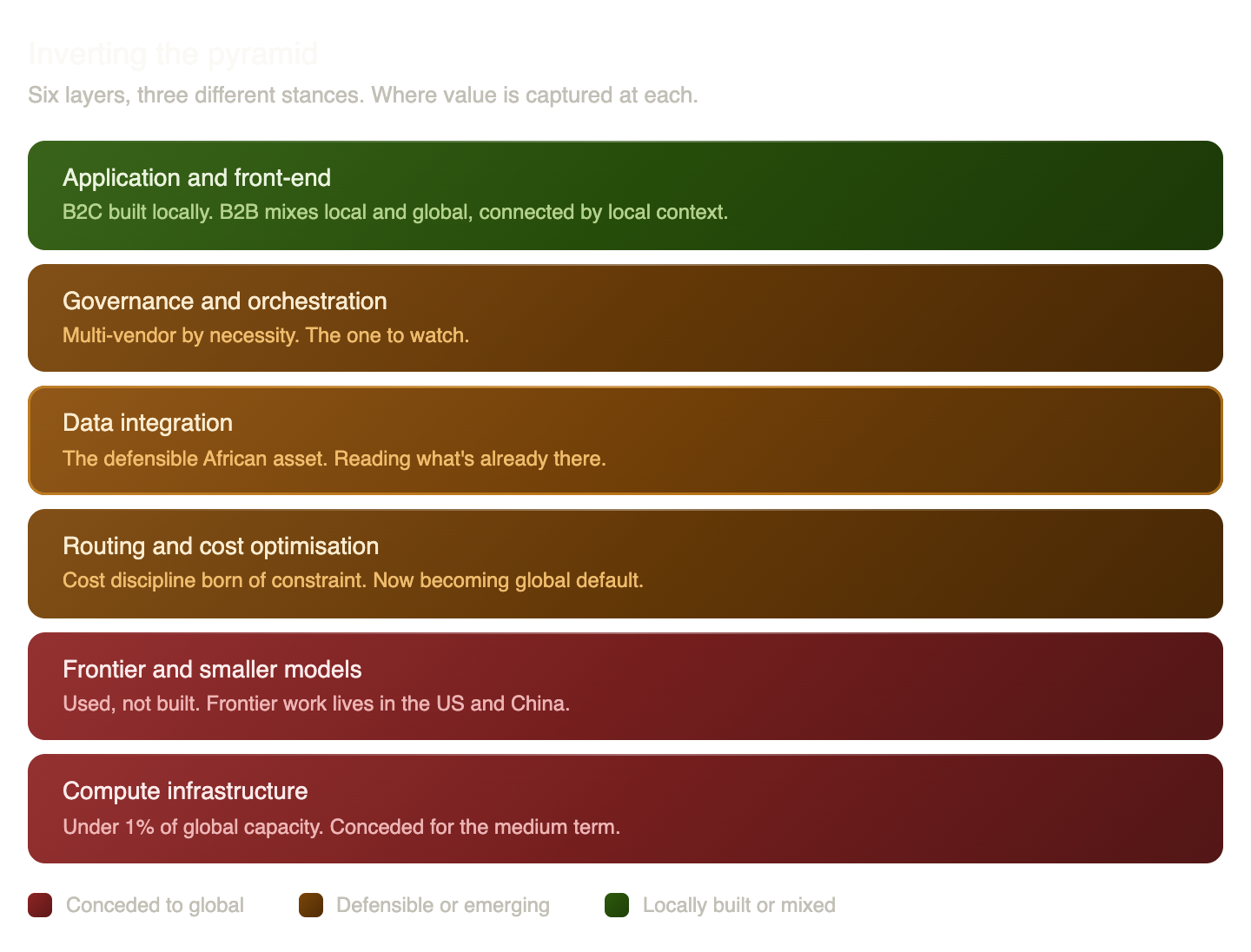
The way I cut it. At the bottom, compute and the physical infrastructure that runs the models. Above that, the models themselves, frontier and smaller. Above that, the layer that decides which model runs which task and at what cost. Above that, the work of getting messy real-world data into a state a model can read, things like paper records, voice notes, agent network exhaust, WhatsApp threads. Above that, governance and the rules of what can be deployed where. And on top of all of it, the application itself, the thing the user actually touches, often in low bandwidth, on a phone, in a language the models weren’t built for. Value can show up at any of these layers. Africa’s position at each is different, and worth thinking about one at a time.
The bottom of the stack, where Africa isn’t.
At the compute and model layers, Africa isn’t a serious player and probably won’t be in the medium term. Under 1% of global data centre capacity against 18% of the world’s population. AWS Bedrock in Cape Town hosts 7 models. Mumbai hosts 59. São Paulo hosts 50. Claude 4.5 in Cape Town is routed cross-region, not in-region. Cassava’s Cape Town AI Factory came online in March 2026 and is genuinely meaningful, but the full five-factory network, at completion, will be 12,000 to 15,000 GPUs, a fraction of a single hyperscaler region. And Cassava itself is majority-funded by Western capital. Google and Nvidia are shareholders. April 2026 saw a $660M debt round. The story is more complicated than the sovereign-AI headlines suggest.
At the frontier model layer, the picture is similar. The capital and compute concentration that produces frontier models lives in the US and China. African builders will use those models. They won’t build them. The Lelapas and Introns of the continent are doing important and impressive work on smaller, more efficient models, but they’re explicitly choosing not to compete at the frontier. “The L stands for little, not large,” as Pelonomi Moiloa put it. Better to say what’s true and move up.
I do see, and hope to see more, distributed small compute capacity, optimised for smaller tasks and models, slower inference, and realistic power demands. It will have a growing role, but it’s additive. It won’t replace the need for the global capabilities that I struggle to see appearing locally for quite some time.
The middle of the stack, where it gets interesting.
Three layers sit in the middle. Routing and cost optimisation. Data integration. Governance and orchestration.
What I see African builders doing on routing. Not chasing the biggest model, but tiering. Low-cost models for high-volume routine work, frontier sparingly for what genuinely needs reasoning. This wasn’t a choice. It was the only way the unit economics worked. The rest of the market is now arriving at the same place. Stanford published a paper showing agentic tasks burn around 1,000 times the tokens of a normal chat workload. Uber burned through its entire 2026 AI budget in four months. Anthropic split its billing in May because Max-plan users were running workloads that would cost $5,000+ at API rates on $200 subscriptions. Multi-model routing platforms are now documenting 40 to 85% savings in production. The discipline African builders adopted from necessity in 2023 is becoming the default architecture for cost-conscious enterprises everywhere in 2026. Not all decisions are born equal. Not all need deep reasoning, and quite a few benefit from better framing, clear rules, and a more appropriate cost base. Finally an African design constraint that actually helps.
On data integration, this is where I think the real defensible African asset lives, and where the discourse is doing the worst job of taking it seriously.
The data that lives inside African enterprises isn't a poorer version of Western data. It's a byproduct of a different economy. Mobile money creates transaction graphs that card networks don't produce. Agent networks create distribution exhaust that retail branches don't generate. Loan officer assessments encode judgment that scored credit bureaus haven't replaced. WhatsApp threads carry conversations that wouldn't have happened anywhere else. None of this is messier behaviour from less-developed customers. It's the actual signal of how the economy runs here, and most of it has never been readable by anything.
The banks, telcos and lenders holding this data already have ML moats built on it. Moniepoint underwrites two million SMEs on POS exhaust. JUMO scores credit on airtime and mobile money signals. Safaricom is layering newer tools on top of years of M-PESA telemetry. What none of them yet has at scale, and what almost no one outside Africa is going to build for them, is the capability to read the messy unstructured layer with the new tools. That capability gap is the actual ten-year opportunity. Not collecting more data, which already exists, but reading what’s already there.
The real risk is erosion, not theft. Some inference will always run on non-African models, and trying to refuse global capability is a worse outcome than using it well. The risk is more boring and more dangerous. Institutions that don’t think carefully about how they partner, what they share, what they govern, and where they retain control end up with the asset eroded by accident. Owning the data in 2026 doesn’t mean keeping it on local servers. It means having the partnership terms, governance discipline, and architectural choices that keep the asset intact while using the best tools available to read it.
Governance and orchestration is less mature, and the one I’d watch most carefully. African enterprises operate across regulatory regimes that don’t match each other, on infrastructure they don’t fully control, with vendors they’re rationally reluctant to depend on. The discipline this forces, multi-vendor, multi-cloud, with a governance layer deciding what runs where, is the same discipline procurement officers in London and New York are now demanding. Different cause, same architecture. Local capabilities are being built, and they’ll open up possibilities for both local and global application players to step in. Unlocking this is key. Without it, Africa may easily be, again, left out.

The top of the stack, where reality and users meet.
The application layer splits along who the user is, and the dynamics on each side are different.
On B2C, local knowledge is the thing. African builders aren’t really building general-purpose front-ends (remember, this piece isn’t about that). They’re building workflow-specific ones, on whatever channel the user actually uses. WhatsApp, USSD, agent banking, sometimes offline or empowering the ‘physical’. Intron’s voice models are built for African accents because no global model handles them well for now. Rising Academies pairs a simple front end with a high-tech back end because that’s what bandwidth-constrained users can actually use. Penda Health built clinician copilots that work in the real conditions of a Kenyan clinic. The moat here isn’t the interface design. It’s the workflow knowledge. Knowing that an M-PESA transaction stream isn’t the same shape as a card stream, that an agent network isn’t a retail branch, that a user on a feature phone in low bandwidth isn’t a user on a MacBook in San Francisco. Global vendors will eventually target this layer hard because it’s the most visible, but the underlying shape of the workflow doesn’t travel cleanly.
On B2B, and especially the large end, the picture is different. Big African corporates are going to use global solutions for a lot of this. They should. The capability bar is high, the global players have invested billions in building it, and trying to rebuild the same thing locally would not always be the best use of capital. The interesting work is in adapting those solutions to local reality. A global contact centre platform doesn’t know how a Nigerian customer actually escalates a complaint, or the fact he sometimes wants to do it over Twitter or Instagram. A global underwriting model doesn’t know what a Kenyan loan officer is reading when they look at a borrower. The standards on the underlying capability have to be world class. The edge is in wiring it to behave well in the local context. This is the role and the opportunity, and it’s a mix, not an either-or. It’s also a lot of what we end up doing at AfricAI.
The honest read across both. The front end will increasingly look similar to front ends elsewhere. What sits behind it, the workflow logic, the data shape, the decision context, the channel reality, is locally specific in ways that don’t travel cleanly. On B2C it’s mostly local builders, by necessity. On B2B it’s mostly global capability adapted by local context partners.
What you point the stack at.
There’s a piece of this that doesn’t sit cleanly inside any of the layers above, but matters at least as much. What you point the stack at. The order in which you choose which workflows to optimise. The decision of what AI is supposed to do for your business.
I wrote a while back about the hierarchy of decision making and how organisational reality reshapes what AI ends up doing inside a company. The same logic applies here, but at the level of business strategy rather than internal decision flow. What I’m seeing is that most enterprises can’t and shouldn’t optimise everything at once. The interesting question isn’t whether to deploy AI. It’s what you deploy it on first, and why.
An African retail bank thinks about credit and collections in a way a US bank doesn’t, because the US bank has card products doing much of that work already and a securitisation market behind it. An African FMCG cares about shortening cash conversion cycles in a way a Western FMCG doesn’t, because FX exposure and working capital costs are doing real damage every month. A telco running mobile money cares about fraud and KYC in ways a Western telco doesn’t, because the regulator changes the rules every few quarters and the consequences land harder.
None of this is about being behind. It’s a different priority order produced by different economics, different balance sheet realities, different regulatory regimes, and different user behaviour. The technology stack is increasingly the same. The playbook for what to do with it isn’t.
On a side note, this is the part where AfricAI’s work lives. Not “should you use AI,” but “what do you point it at first given who you are and where you operate.” The answer for a Nigerian Tier-1 bank is materially different from the answer for a South African retailer, and both require an understanding and the right design across the full stack.
The integration piece nobody talks about.
Something I keep coming back to. Every serious enterprise software cycle has played out the same way. For every dollar of Salesforce licence, the world spent around six dollars on integration and services. IDC has tracked this for a decade and the multiplier keeps growing, not shrinking. AI looks like it needs more integration work than CRM did, not less. Context engineering, fine-tuning, evals, agentic orchestration, governance, none of it gets cheaper even if the model does.
The market is acknowledging this in real time. Anthropic launched a $1.5B services joint venture with Blackstone, Hellman and Friedman, and Goldman Sachs on May 4. OpenAI launched a $4B-plus Deployment Company on May 11. Both modelled on Palantir, which runs 84% gross margins on a services-heavy approach and grew 85% year on year. The frontier labs themselves are conceding that the model alone doesn’t deploy.
The work the African builders I’m watching are doing, routing, governance, data integration, channel-native front-ends, is the integration layer the rest of the market is now building toward. We started earlier, with less.
The constraint that might surprise.
The architecture being forced on builders here looks a lot like where enterprise AI elsewhere is heading. Cost discipline through routing. Governance and orchestration across multiple vendors. Behavioural data integration. Channel-native front-ends for users who aren't sitting at a laptop in San Francisco.
I think this matters globally, but I don't know how much yet. The architecture is interesting on its own, and the conversations I'm having with builders here are different from the conversations I read about builders elsewhere. Not because Africa is special, but because the constraints force choices that most of the global AI clusters didn't have to make (yet). Worth watching what gets built in the window.
This is one week’s thinking. Next month it might look different. The stack framing is just a way to cut a topic that otherwise starts feeling too big to discuss. The thing I’m most confident about is that the playbook for AI in Africa isn’t going to look like the playbook elsewhere. Verdict is still out on where it takes us, and on the global long-term relevance of that.
Push back. Preferably with your own views and less with the ones from AI. As always, I’d rather have a real passionate argument over just feeling right. One of the (still standing) perks of being human. Looking forward to more of that.